








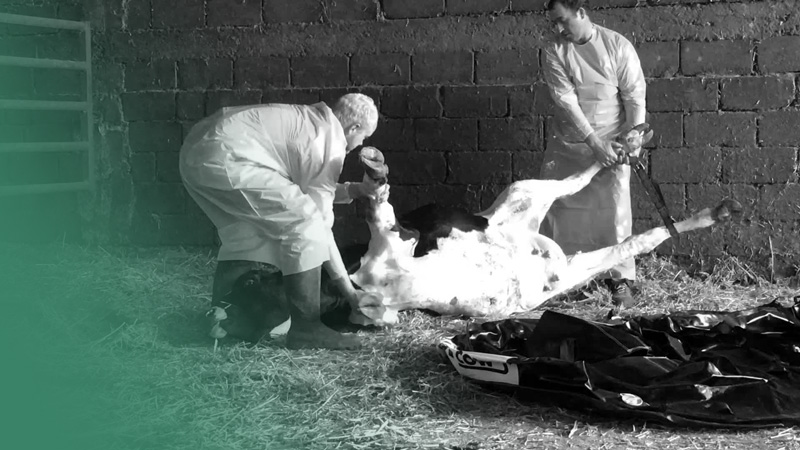
Lifting a 700 kg cow that can no longer stand is no small task. Several methods exist, from the oldest to the most modern. They are not all equal: some can make the animal's condition worse. Here is an honest comparison, seen from the field.
The hip clamp: fast but painful
The hip clamp attaches to the pelvic bones and lifts the hindquarters with a hoist or a front loader. It is the most widespread method because it is cheap and quick.
Its limitations are serious, though:
- The compression on the hips is painful and can cause haematomas, nerve damage and pelvic fractures.
- The cow is suspended, not supported: the front end stays on the ground if she does not cooperate.
- Use is limited to short sessions — impossible to keep the animal standing for hours.
- Repeated use degrades the animal's condition and her willingness to cooperate.
Slings and harnesses: better, but complex
Belly sling and harness systems spread the weight over a larger surface. Correctly fitted, they are less traumatic than the clamp.
In practice, fitting them under a 700 kg recumbent animal is difficult and slow, often requires several people, and the pressure points under the abdomen remain problematic during prolonged support: impaired breathing and digestion, pressure sores at the contact points.
Flotation therapy: effective but clinic-only
The flotation tank, where the cow is placed in warm water, gives excellent recovery results. But it requires a fixed installation, transporting the animal to the clinic, large amounts of warm water and constant supervision — out of reach for the vast majority of farms.
The pneumatic lifting cushion: physiological lifting
The air cushion, such as the Air-cow system, is slid deflated under the animal and then progressively inflated with a compressor. The cow is raised in about ten minutes, supported across the whole surface of her body, without a single pressure point.
The advantages of the air cushion
- Progressive, painless lifting in a physiological position
- No pressure points: no haematomas or nerve damage
- The animal can stay in the device for hours or days, with only occasional monitoring
- The cow can eat and drink normally during her recovery
- Set up by one or two people, in the barn or in the pasture
- Also allows the transport of an animal unable to walk
Verdict: which method for which situation?
For a very brief lift of a few minutes with a cooperative animal, a properly used hip clamp can help out. As soon as recovery takes time — milk fever, post-calving sciatic syndrome, septic shock, trauma — only compression-free support allows prolonged standing without creating new injuries. That is exactly what pneumatic lifting provides: the time needed to heal, with full respect for animal welfare.
