








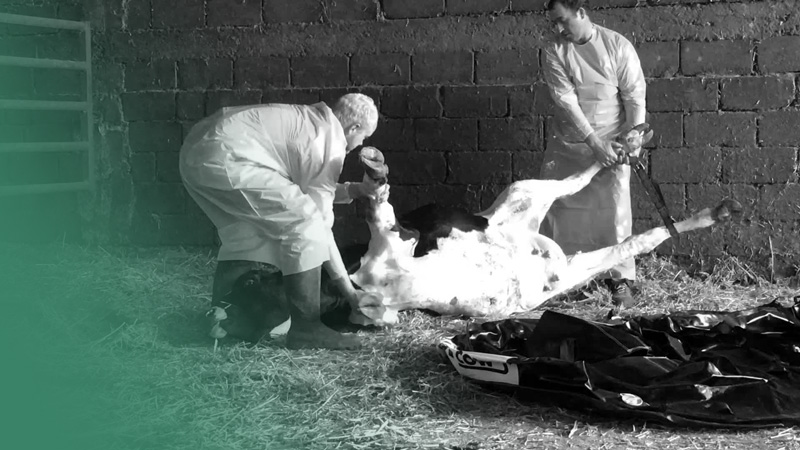
Lifting a 700 kg cow that can no longer stand on her own is no simple task. Several methods exist, from traditional tools to modern solutions. However, not all are equally suitable, and some can even worsen the animal's condition. Here's an objective comparison based on real-world experience.
The hip clamp: fast, but potentially painful
A hip clamp is placed on the bony points of the pelvis and lifts the hindquarters using a winch or front loader. It's the most widely used method because it's inexpensive and quick to deploy.
However, the method has significant limitations:
- Pressure on the hips can be painful and cause bruising, nerve damage or pelvic fractures.
- The cow is suspended rather than supported: the forequarters remain on the ground if she cannot actively assist with the lift.
- Use must be limited to short sessions, as it cannot keep the animal upright for several hours.
- Repeated use can worsen the animal's condition and reduce her ability to assist with lifting.
Straps and harnesses: gentler, but more complex
Belly-strap and harness systems distribute the animal's weight over a larger surface area. When properly fitted, they are less stressful than a hip clamp.
In practice, however, fitting them under a recumbent 700 kg animal is difficult and time-consuming, often requiring several people. For extended support, the pressure points under the belly can also cause problems by restricting breathing and digestion or causing pressure sores at contact points.
Flotation therapy: effective, but usually clinic-only
A flotation tank, in which the cow is supported by warm water, can produce excellent recovery results. However, it requires a fixed installation, transporting the animal to a clinic, large quantities of warm water, and constant supervision. This makes it impractical for most farms.
The pneumatic lifting cushion: physiological lifting
An air cushion like the Air-cow system is slid, deflated, under the animal and then gradually inflated with a compressor. The cow is lifted within about ten minutes and supported over her entire body surface, without creating concentrated pressure points.
The advantages of the air cushion
- Gradual, painless lifting into a natural, physiological position
- No concentrated pressure points, reducing the risk of bruising and nerve damage
- The animal can remain in the device for several hours or even days, with only periodic monitoring
- The cow can eat and drink normally during recovery
- The cushion can be set up by one or two people, in the barn or in the pasture
- Even an animal that cannot walk can be moved with it
Conclusion: which method for which situation?
For very briefly lifting a cooperative animal, a correctly used hip clamp can offer a temporary solution. When recovery requires more time — for example with milk fever, obturator paralysis after calving, septic shock, or trauma — only a device with no concentrated pressure points can support the animal over the long term without causing new injury. That's exactly what pneumatic lifting offers: the time and support needed for recovery, with full attention to animal welfare.
