








Milk fever — also known as puerperal hypocalcemia — is one of the most common metabolic diseases in dairy cows. It occurs around calving, when the sudden onset of milk production places heavy demand on the animal's calcium reserves. Left untreated, milk fever can become fatal within hours. With prompt treatment, it typically responds very well.
What is milk fever?
At the start of lactation, colostrum production requires a large amount of calcium. If the body cannot mobilize calcium stored in the bones quickly enough, blood calcium levels drop. Calcium is essential for muscle contraction: the cow weakens, begins to tremble, lies down, and can eventually no longer stand.
Despite its name, milk fever usually does not involve a fever. Body temperature remains normal or can even be lower than normal.
The three stages of hypocalcemia
Stage 1 — the cow is still standing
Early signs include unusual excitability, muscle tremors, cold ears, and a stiff, unsteady gait. This stage often goes unnoticed and may last only a few hours.
Stage 2 — the cow is lying chest-down
The cow can no longer stand and often holds her head turned toward her flank in the characteristic “S-neck” position. She may also have a dry muzzle, cold extremities, slowed digestion and dilated pupils.
Stage 3 — the cow is lying flat on her side
The animal gradually loses consciousness and may develop bloat and an increased risk of choking and aspiration. Without treatment, death can occur within hours.
Emergency treatment
Standard treatment involves a slow intravenous calcium infusion administered by a veterinarian, often supplemented with phosphorus and magnesium. The response can be remarkably fast: many cows stand up again within a few hours.
Watch out for the vicious cycle
- A cow that stays down too long develops pressure-related muscle damage
- This damage can prevent her from standing even after blood calcium levels are restored
- Every failed attempt to lift her worsens the injury and further exhausts the animal
- This is one of the main causes of chronic downer cow syndrome after milk fever
Lifting: an often-overlooked step
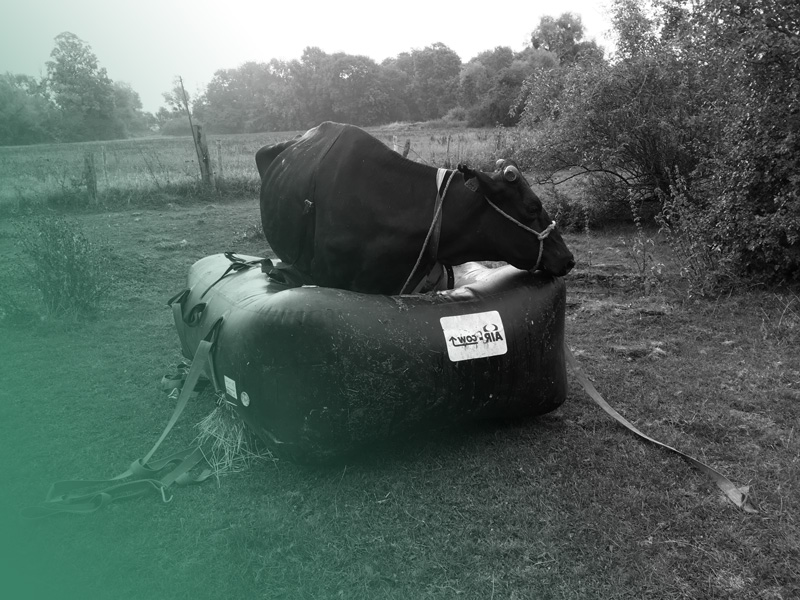
If the cow does not stand up in the hours after the infusion, she should be gently and supportedly lifted. A pneumatic lifting cushion like Air-cow gradually brings the animal back into a natural, physiological standing position within about ten minutes, without compression or pain. The cow can remain safely in the device and eat and drink while her muscles recover.
Real-world experience shows that a cow with milk fever recovers significantly faster when, in addition to calcium treatment, she is lifted early with an air cushion. This also helps prevent the complications of prolonged recumbency.
Prevention
- An adjusted dry period diet: limit calcium and potassium intake before calving, or use a diet with a negative dietary cation-anion balance (DCAB).
- Calcium boluses or gels: administer around calving to at-risk cows, particularly those in their third lactation or beyond, or with a history of milk fever.
- Close monitoring: carefully monitor cows during the first 48 hours after calving, the period when 80% of cases occur.
- Appropriate body condition: cows that are over-conditioned at calving are at greater risk.
